Black Holes

Introduction

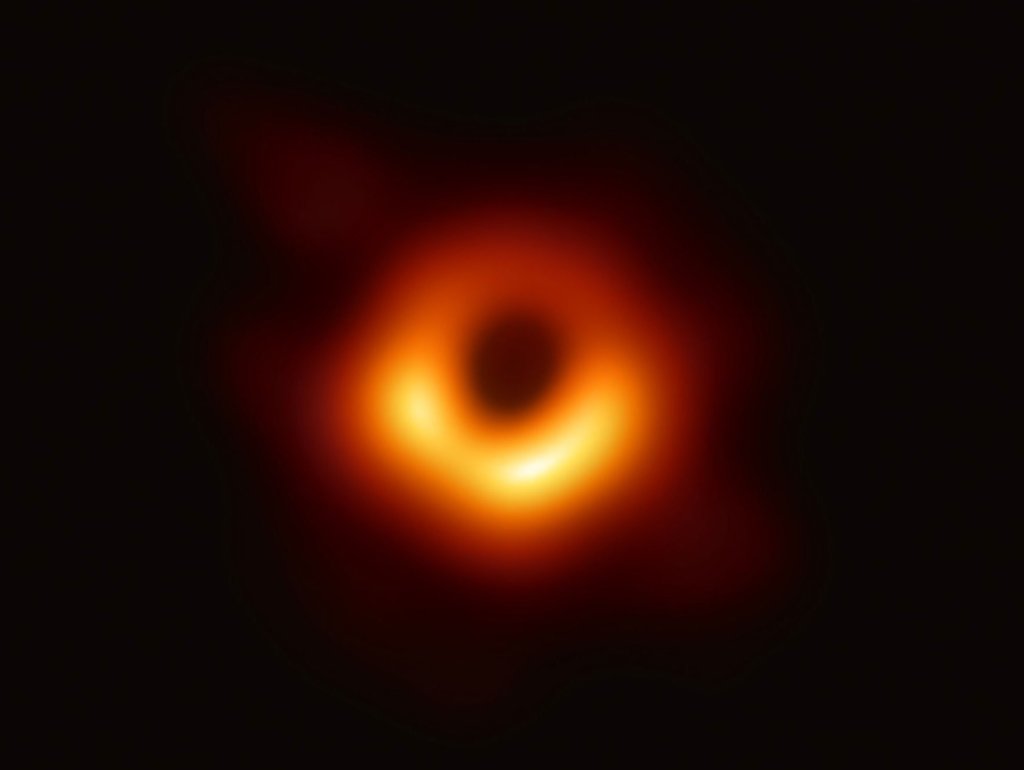
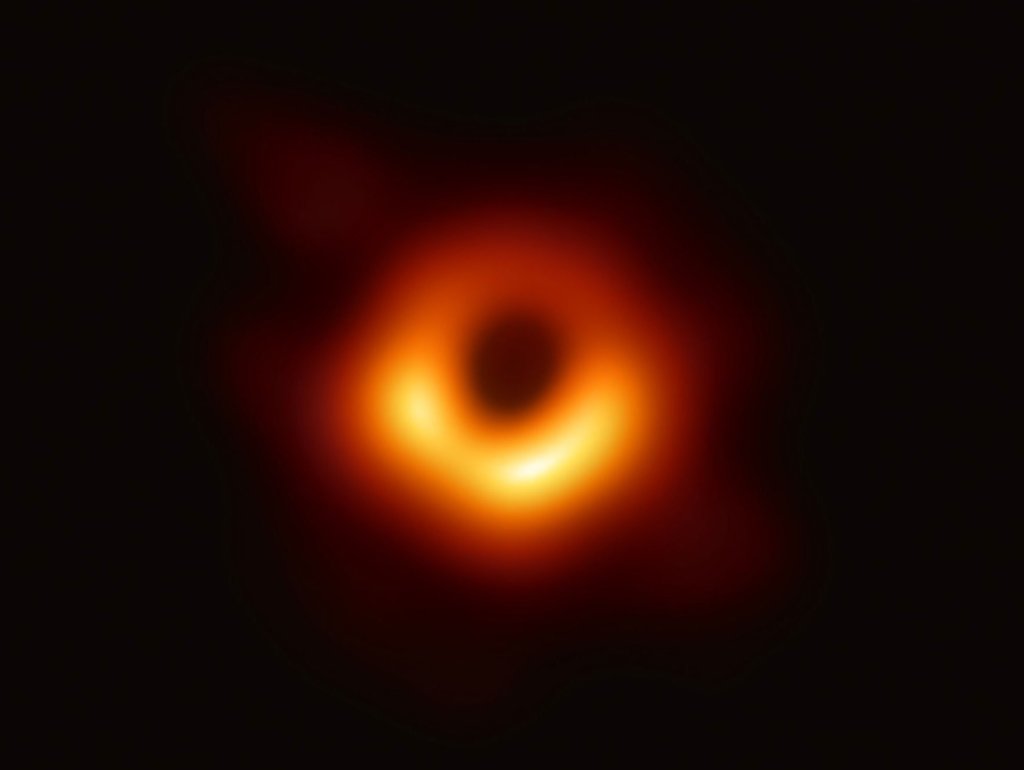
The supermassive black hole at the core of supergiant elliptical galaxy Messier 87, with a mass ~7 billion times the Sun’s, as depicted in the first image released by the Event Horizon Telescope (10 April 2019).

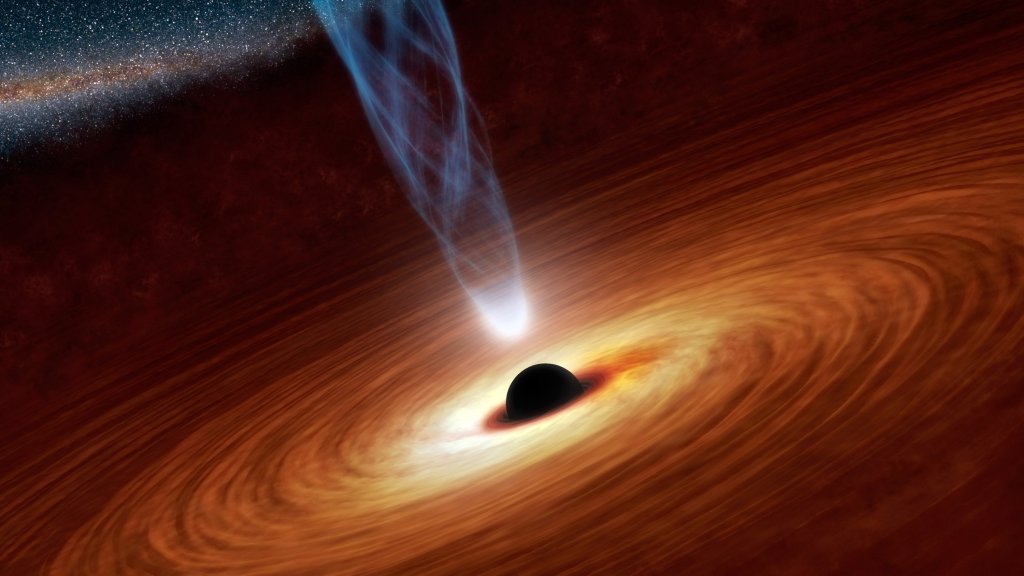
black hole is a region of spacetime where gravity is so strong that nothing—no particlesor even electromagnetic radiation such as light—can escape from it.The theory of general relativity predicts that a sufficiently compact mass can deform spacetime to form a black hole.The boundary of the region from which no escape is possible is called the event horizon. Although the event horizon has an enormous effect on the fate and circumstances of an object crossing it, it has no locally detectable features. In many ways, a black hole acts like an ideal black body, as it reflects no light.Moreover, quantum field theory in curved spacetime predicts that event horizons emit Hawking radiation, with the same spectrumas a black body of a temperature inversely proportional to its mass. This temperature is on the order of billionths of a kelvin for black holes of stellar mass, making it essentially impossible to observe.
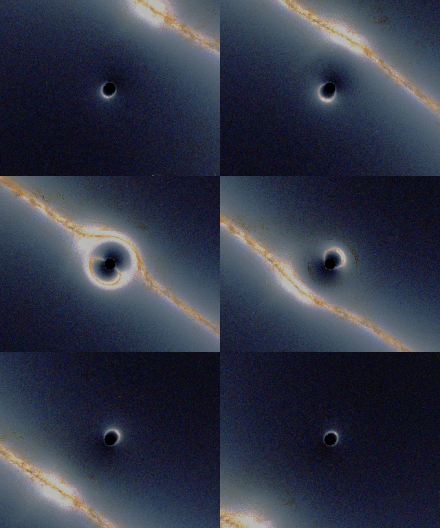

Simulation of gravitational lensing by a black hole, which distorts the image of a galaxy in the background

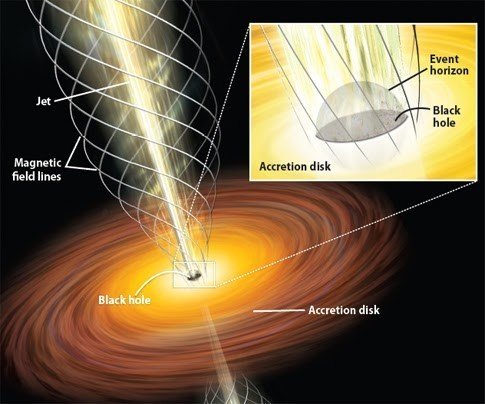
Event Horizon

The defining feature of a black hole is the appearance of an event horizon—a boundary in spacetime through which matter and light can pass only inward towards the mass of the black hole. Nothing, not even light, can escape from inside the event horizon. The event horizon is referred to as such because if an event occurs within the boundary, information from that event cannot reach an outside observer, making it impossible to determine whether such an event occurred.

As predicted by general relativity, the presence of a mass deforms spacetime in such a way that the paths taken by particles bend towards the mass.At the event horizon of a black hole, this deformation becomes so strong that there are no paths that lead away from the black hole.

To a distant observer, clocks near a black hole would appear to tick more slowly than those further away from the black hole.Due to this effect, known as gravitational time dilation, an object falling into a black hole appears to slow as it approaches the event horizon, taking an infinite time to reach it.At the same time, all processes on this object slow down, from the view point of a fixed outside observer, causing any light emitted by the object to appear redder and dimmer, an effect known as gravitational redshift. Eventually, the falling object fades away until it can no longer be seen. Typically this process happens very rapidly with an object disappearing from view within less than a second.
Event Horizon

Singularity

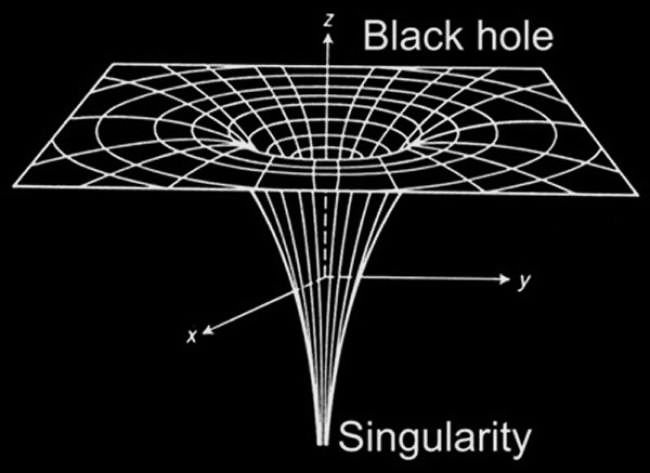
At the center of a black hole, as described by general relativity, may lie a gravitational singularity, a region where the spacetime curvature becomes infinite. For a non-rotating black hole, this region takes the shape of a single point and for a rotating black hole, it is smeared out to form a ring singularity that lies in the plane of rotation. In both cases, the singular region has zero volume. It can also be shown that the singular region contains all the mass of the black hole solution. The singular region can thus be thought of as having infinite density.

Observers falling into a Schwarzschild black hole (i.e., non-rotating and not charged) cannot avoid being carried into the singularity, once they cross the event horizon. They can prolong the experience by accelerating away to slow their descent, but only up to a limit. When they reach the singularity, they are crushed to infinite density and their mass is added to the total of the black hole. Before that happens, they will have been torn apart by the growing tidal forces in a process sometimes referred to as spaghettification or the “noodle effect”.
Contact information

Name: Yuvraj Singh Chauhan

Roll.no: 20191CSE0718

Section: PC18
Life of a STAR

Introduction

Stars do not live forever, just like people. Stars are born, live their lives, changing or evolvingas they age, and eventually they die. Often stars do this in a much more spectacular way than humans do!

Scientists speak of stellar evolution when talking about the birth, life and death of stars. The lifetime of individual stars is way too long for humans to observe the evolution of a single star, so how do scientists study stellar evolution? This is possible as there are so many stars in our galaxy, so we can see lots of them at different stages of their lives. In this way, astronomers can build up an overall picture of the process of stellar evolution. In this chapter you will discover how stars are born, how they evolve, and how they die.

Birth

Stars are born in vast, slowly rotating, clouds of cold gas and dust called nebulae (singular nebula). These large clouds are enormous, they have masses somewhere between 100 thousand and two million times the mass of the Sun and their diameters range from 50 to 300 light years across.

The “Pillars of creation”. These giant, dense dusty clouds of hydrogen gas are vast stellar nurseries where new stars are born. (NASA)

Life

A star is considered to be ‘born’ once nuclear fusion reactions begin at its centre. Initially hydrogen is converted to helium deep inside the star. A star that is converting hydrogen to helium is called a main sequence star. Stars spend most of their lives as main sequence stars, converting hydrogen to helium at their centres or cores. A star may remain as a main sequence star for millions or billions of years.

This artist’s impression shows the relative sizes of young stars, from the smallest “red dwarfs”, at about 0.1 solar masses, low mass “yellow dwarfs” such as the Sun, to massive “blue dwarf” stars weighing eight times more than the Sun, as well as the 300 solar mass star named R136a1.

How long a main sequence star lives depends on how massive it is. More massive stars move onto the next stages of their lives more quickly than lower mass stars. In fact they are main sequence stars for a shorter time than lower mass stars.

A higher-mass star might have more material, but it also uses up the material more quickly due to its higher temperature. For example, the Sun will spend about 10 billion years as a main sequence star, but a star 10 times as massive will last for only 20 million years. A red dwarf, which is half the mass of the Sun, can last 80 to 100 billion years.

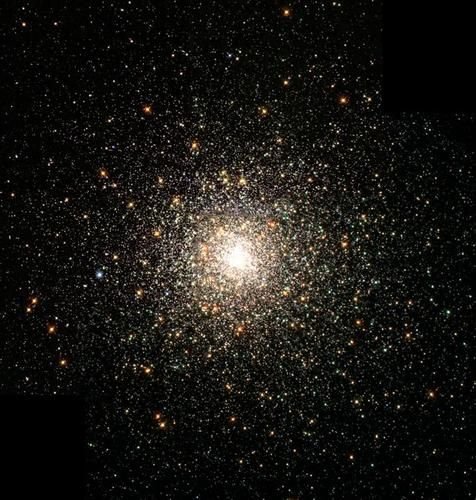
A colourful view of the globular star cluster NGC 6093 in the Milky Way, containing hundreds of thousands of ancient stars. Especially obvious are the bright red giants, which are stars similar to the Sun in mass that are nearing the ends of their lives.

When the hydrogen in the centre of the star is depleted, the star’s core shrinks and heats up. This causes the outer part of the star, the star’s atmosphere, which is still mostly hydrogen, to start to expand. The star becomes larger and brighter and its surface temperature cools so it glows red. The star is now a red giant star. Betelgeuse, as you observed in the last activity, is a red giant star.

Eventually the core of the star becomes hot enough for the next nuclear reaction to start: atoms of helium collide and fuse into heavier elements such as carbon and oxygen. However, eventually the helium in the core will also be depleted. From this point onwards, the fate of the star is determined by its mass.

Death

As a star enters the final stages of its life, after it has become a red giant, the star becomes unstable and expands and contracts over and over. This causes the star’s outer layers to become detached from the central part of the star and they gently puff off into space. When the last of the gas in the star’s outer layers is blown away, it forms an expanding shell around the core of the star called a planetary nebula. Planetary nebulae glow beautifully as they absorb the energy emitted from the hot central star. They can be found in many different shapes.

The Butterfly Nebula. The dying central star itself cannot be seen, because it is hidden within a doughnut-shaped ring of dust.
The Helix Nebula.

The central star left behind is either made of neutrons and it is called a neutron star, or if the initial star was really massive, a black hole forms. The leftover neutron star or black hole is surrounded by an expanding cloud of very hot gas.

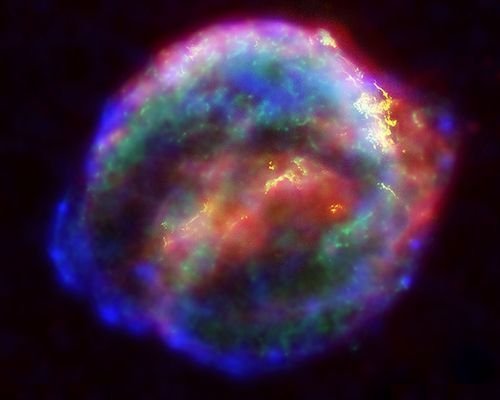
The remnants of Kepler’s supernova. The explosion was observed in 1604.
In our minds
In reality

Contact information

Name : Yuvraj Singh Chauhan

Roll.no : 20191CSE0718

Sec : PC18

Interstellar travel

Introduction

Interstellar travel is crewed or uncrewed travel between stars or planetary systems. Interstellar travel would be much more difficult than interplanetary spaceflight. Whereas the distances between the planetsin the Solar System are less than 30 astronomical units (AU), the distances between stars are typically hundreds of thousands of AU, and usually expressed in light-years. Because of the vastness of those distances, practical interstellar travel based on known physics would need to occur at a high percentage of the speed of light, allowing for significant travel times, at least decades to perhaps millennia or longer.

What do we know…

The speeds required for interstellar travel in a human lifetime far exceed what current methods of spacecraft propulsion can provide. Even with a hypothetically perfectly efficient propulsion system, the kinetic energy corresponding to those speeds is enormous by today’s standards of energy development. Moreover, collisions by the spacecraft with cosmic dust and gas can produce very dangerous effects both to passengers and the spacecraft itself.

A number of strategies have been proposed to deal with these problems, ranging from giant arks that would carry entire societies and ecosystems, to microscopic space probes. Many different spacecraft propulsion systems have been proposed to give spacecraft the required speeds, including nuclear propulsionbeam-powered propulsion, and methods based on speculative physics.

For both crewed and uncrewed interstellar travel, considerable technological and economic challenges need to be met. Even the most optimistic views about interstellar travel see it as only being feasible decades from now. However, in spite of the challenges, if or when interstellar travel is realized, a wide range of scientific benefits is expected.

What would it look like?

Required energy

A significant factor contributing to the difficulty is the energy that must be supplied to obtain a reasonable travel time. A lower bound for the required energy is the kinetic energy {\displaystyle K={\tfrac {1}{2}}mv^{2}} where {\displaystyle m} is the final mass. If deceleration on arrival is desired and cannot be achieved by any means other than the engines of the ship, then the lower bound for the required energy is doubled to {\displaystyle mv^{2}}.

The velocity for a manned round trip of a few decades to even the nearest star is several thousand times greater than those of present space vehicles. This means that due to the {\displaystyle v^{2}} term in the kinetic energy formula, millions of times as much energy is required. Accelerating one ton to one-tenth of the speed of light requires at least 450 petajoules or 4.50×10¹⁷ joules or 125 terawatt-hours (world energy consumption 2008 was 143,851 terawatt-hours),without factoring in efficiency of the propulsion mechanism. This energy has to be generated onboard from stored fuel, harvested from the interstellar medium, or projected over immense distances.

Hopes for the future…

NASA has been researching interstellar travel since its formation, translating important foreign language papers and conducting early studies on applying fusion propulsion, in the 1960s, and laser propulsion, in the 1970s, to interstellar travel.

Propulsion

The NASA Breakthrough Propulsion Physics Program (terminated in FY 2003 after a 6-year, $1.2-million study, because “No breakthroughs appear imminent.”)identified some breakthroughs that are needed for interstellar travel to be possible.

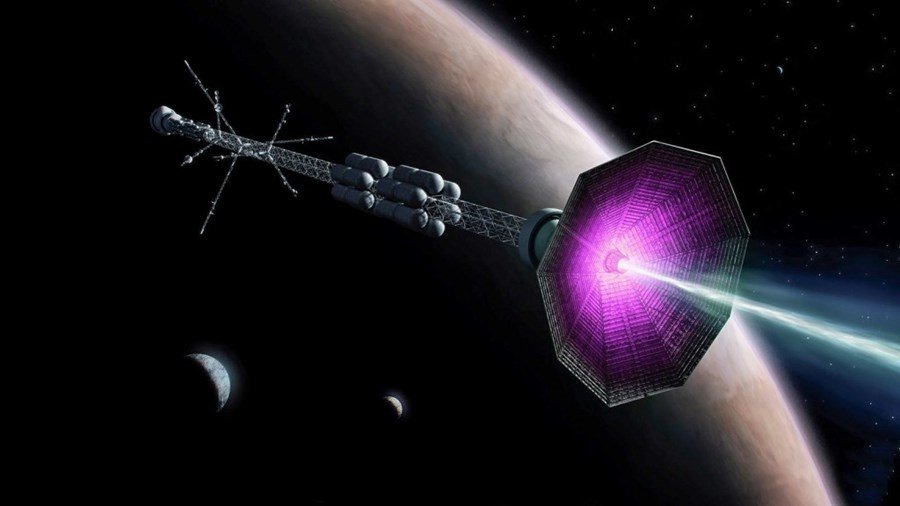
Geoffrey A. Landis of NASA’s Glenn Research Center states that a laser-powered interstellar sail ship could possibly be launched within 50 years, using new methods of space travel. “I think that ultimately we’re going to do it, it’s just a question of when and who,” Landis said in an interview. Rockets are too slow to send humans on interstellar missions. Instead, he envisions interstellar craft with extensive sails, propelled by laser light to about one-tenth the speed of light. It would take such a ship about 43 years to reach Alpha Centauri if it passed through the system without stopping. Slowing down to stop at Alpha Centauri could increase the trip to 100 years,whereas a journey without slowing down raises the issue of making sufficiently accurate and useful observations and measurements during a fly-by.

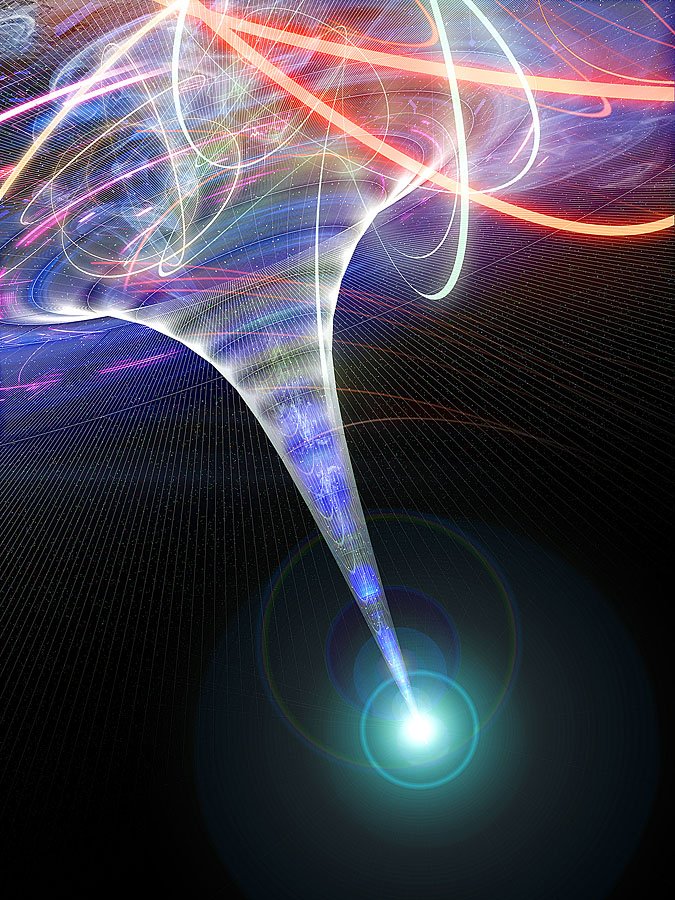
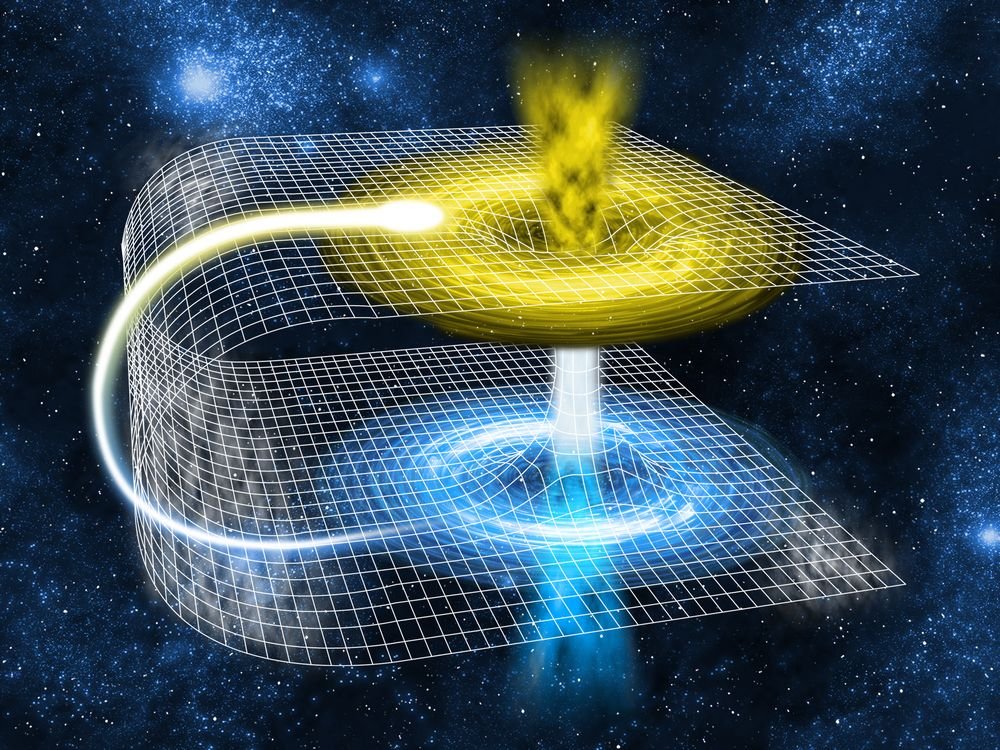
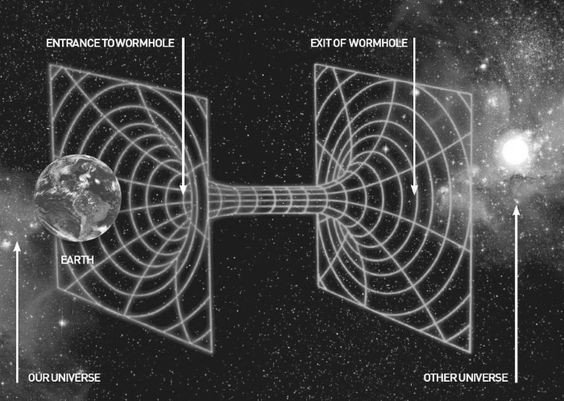
A theoretical method to travel between two galaxies is to travel through a Wormhole. A wormhole (or Einstein–Rosen bridge or Einstein–Rosen wormhole) is a speculative structure linking disparate points in spacetime, and is based on a special solution of the Einstein field equations. A wormhole can be visualized as a tunnel with two ends at separate points in spacetime (i.e., different locations, or different points in time, or both.)

Basically
Theoretically

Contact information

Name: Yuvraj Singh Chauhan

Roll. No: 20191CSE0718

Class: PC18

Presidency University Bengaluru